
Summary of history of the convent building:
1867: Original convent building completed on ‘greenfield’ site, i.e. chapel block and boarding school block to the north – George Goldie Architect.
1889: Extension completed – William Henry Byrne Architect.
1987: Modern extension (completing the quadrangle) completed.
2008: Closure of the convent.
2024: The Sisters of Mercy, Western Province, entrusted the building to the Ballina Convent Regeneration CLG to use as a benefit to the community.
The original convent was designed by architect George Goldie. The layout as shown was the first manifestation of the convent and comprised two main buildings. The large main building contains the chapel and other rooms at ground floor and presumably the living quarters at first floor, as exists at present. The northernmost building appears to have been a boarding school for girls until the 1889 extension was built.
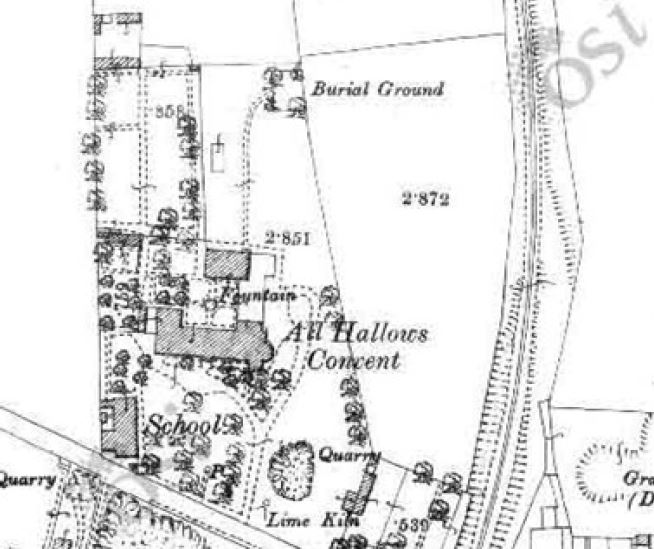
OS 25-inch c.1880s
The extended building of 1889 by architect William Henry Byrne became primarily a convent and secondary school, called St. Mary’s Immediate School. This new extension was a faithful extension of George Goldie’s original building in terms of continuation of overall plan and sectional forms, elevational layouts and architectural detailing. Most of the ground floor comprised chapel, classrooms and ancillary school spaces. The first floor comprised bedroom and associated accommodation.

OS Map 6 inch Last Edition early 1900s
Various other stand-alone facilities were constructed on the site through the 20th century. The final extension to the original convent building was completed in 1987 and the extension coincided with the opening of a new purpose-built school on the site. This extension closed the block to form a quadrangle and was designed in a modern style, retaining the basic scale
and form of the original blocks with some design references to the original stone detailing to be seen at windows. This extension coincided with the construction of a purpose-built school on the site.
Excerpt from ‘Dear Old Ballina’ by Ballina Author Terry Reilly
“The Convent of the Immaculate Conception All Hallows, Ballina, is the home of the Sisters of Mercy, who arrived from Sligo on 14/10/1851. Their arrival followed many requests from Very Rev. Patrick Malone, the Ballina administrator who was anxious to improve social and education standards in the aftermath of the dreadful famine.
They were led by Reverend Mother De Sales, obviously a very resourceful woman who had overcome many difficulties, not the least of them being the furnishing of their house on Pearse St. The house had belonged to Dr. Barrett, executed for his part in the 1798 rebellion and in more recent times house the Munster and Leinster Bank before being demolished with an adjoining property to make way for the new Allied Irish Bank premises. When the Sisters arrived the house was unfurnished, but Fr Malone asked the people of the town to provide furniture and utensils. They obliged but some days later surprised the Sisters by reclaiming their property.
The Sisters moved to Primrose Hill some ten days later (the house is now owned by the Quinn family) and, by 1855, they could be found in more spacious accommodation at Arthur Street (now the Community Centre), by which time the community had grown to eight, including four postulants.
The convent building which we have all come to know was designed by Mr Goldie of London at the request of Very Rev. Patrick Irwin, the administrator of the parish and a great benefactor of the Sisters, and the foundation stone was laid by the bishop of Killala, Most Rev. Dr. Feeny on September 13th, 1863. A four-acre site had been acquired at four pounds per acre on a lease of 999 years from Mr John Bourke. Finding the money to erect the convent building to house the Sisters proved a difficult task but by May of 1867it was sufficiently advanced to move into and it was duly blessed before a huge congregation. But it
was far from finished. Fr. Irwin wanted to go to America to raise funds for its completion. He was sent, however, as parish priest to Kilglass. He moved to his new parish on August 24th of that year, the same evening as the reception of four young Sisters took place, the sermon being preached by Fr. Fortescue, S.J.
Dr. Hugh Conway exceeded Dr. Feeney as Bishop and Fr. Irwin sought permission to go to America to raise funds for the Convent building. It was granted and he raised enough money to complete the front wing. It seems he stayed too long, however, and on his return was deprived of his parish, but was befriended by the Sisters who visited daily: he is still prayed for daily n all the Sisters’ houses. He was laid to rest in Kilglass cemetery. (The cost of
building the Convent was twenty thousand pounds).
The Sisters, upon their arrival in Ballina, opened several schools, the first being the girls’ N.S. on December 8th 1851. The Benefit School opened its doors in January, 1853, and all the ‘’respectable catholic children of the town attended’’. Country girls took lodgings in town to attend. Around that time, too, the Sisters opened and Poor School on Ardnaree Hill, mainly for girls, though some boys also attended, in a disused corn store.
It was a rough time for the nuns, who literally never know where the next penny was coming from. But they survived and in 1885 they were able to open their new school, adjoining the Convent proper. Support for the project had been gaining momentum for three or four years, and the building cost the princely sum of nineteen hundred pounds. Over seven hundred pounds was raised by public subscription and eight hundred pounds was borrowed at three
per cent interest. The Sisters also operated an orphanage at the time at the Convent shortly after it was opened, and there, boys were taught net-making and other trades. The nuns were Sisters of Mercy Convent, Ballina A.H.I.A. and Conservation Report also prominently associated with the Workhouse, taking up duty there in May of 1895, and later still, assumed charge of the District Hospital. A very comprehensive record of the Sisters of Mercy is given by Monsignor McHale in his South Tirawley edition of ‘The Parishes in the Diocese of Killala’.
The upper portion was at first for the seniors and the lower for the babies, with a gallery room for the youngest children. For a number of years, a boarding school for girls operated in the Northern wing of the Convent. It closed in the 1880s to make way for a new secondary school which, when opened,
was called St. Mary’s Intermediate School. Very few records of the early years of this school exists up to 1911. Even the principal’s name is unknown. Subsequent principals were Sister Anne McGoohan (1913-1943); Sister Philomena (1943-1960); Mother M. Benedict 1960-1972); Sister Genevieve 1972-1981; Sister Attracta Tighe (1981-). In 1926 the Intermediate School became an ‘’A’’ School teaching all subjects through Irish – a policy that continued to 1965.
The nuns have added on many other facilities for teaching and recreation, including the assembly hall which was opened a few years ago, and of course St. Mary’s Secondary School. The latest expansion to this school took place in 1987 when the new split-level building of 2,350m sq. was opened. The local contribution to the cost was € 150,000″.
For a full history of the Sisters of Mercy Convent please email us.
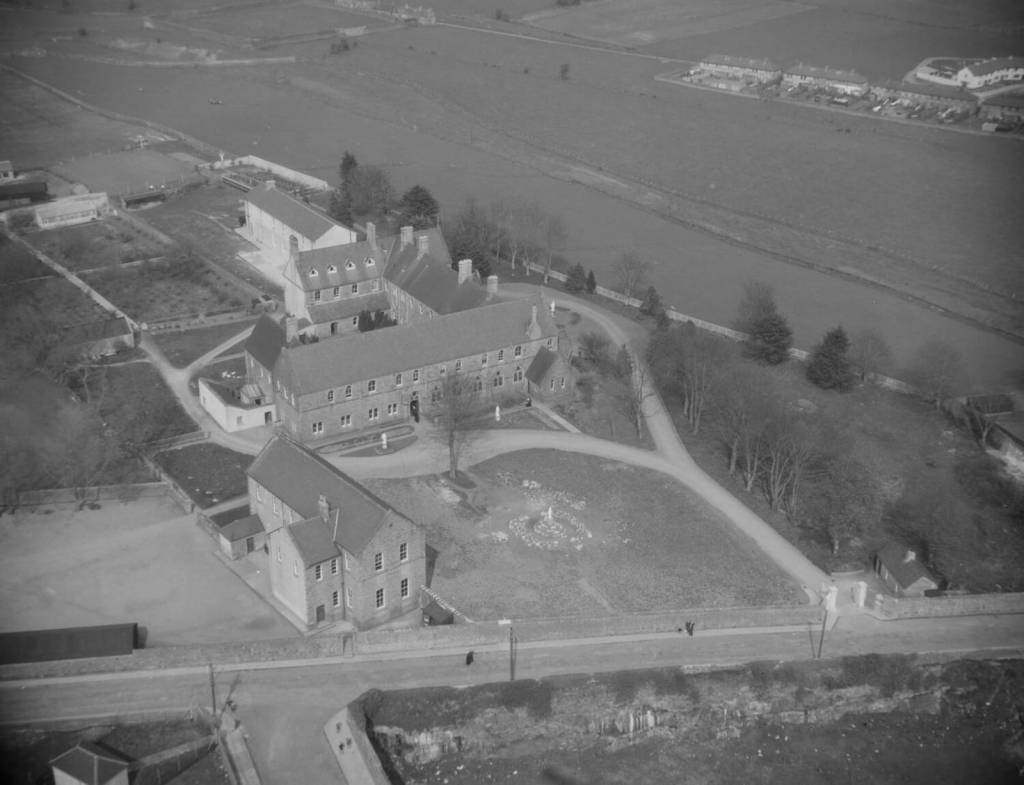
Aerial Photograph of the Convent in the Late 1940s or Early 1950s
 Ballina Convent Regeneration CLG